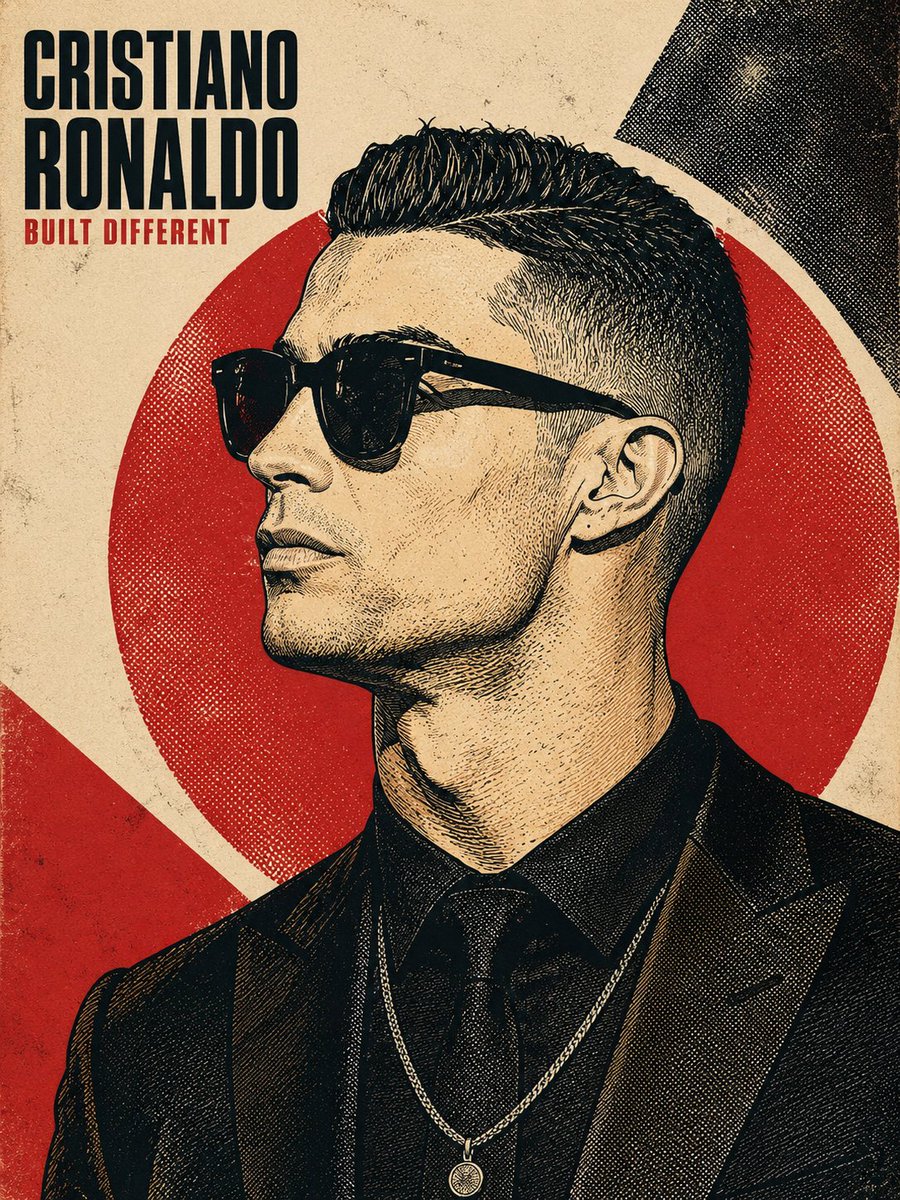
Create a refined vintage halftone poster-art portrait of {{PERSON_NAME}}. Use the uploaded reference photo when provided; otherwise, create the likeness from the named person. The final image must be a full-bleed illustration only, with no reference-photo thumbnail or inset image.

Render the subject in a bold 1960s–70s screen-printed / offset-lithograph aesthetic, inspired by vintage political posters, protest art, retro magazine covers, concert posters, and stencil-based graphic illustration. Preserve recognizable facial proportions and identity while translating the face into high-contrast ink linework, cross-hatching, stippling, halftone dots, and engraved-style shading. Avoid photorealism, airbrushing, and smooth gradients.

Composition: strict 90-degree side profile facing left, eyes looking forward, chin slightly lifted, confident neutral expression. Frame the head and upper shoulders/chest vertically in a 4:5 or 3:4 composition, with the subject occupying roughly 70–85% of the frame. Place a large solid-color sun/halo circle behind the head, with the hair and shoulders slightly breaking its edge. Make the hair highly detailed, with flowing individual strands, directional movement, and graphic highlight streaks.

Background: aged cream, paper, or canvas texture with asymmetric geometric color blocks, subtle halftone patterns, crosshatching, analog print grain, and slight screen-print imperfections. Keep the design sophisticated and cohesive rather than cluttered.

Color direction: automatically choose one limited, high-contrast palette of 2–4 colors. Default to warm aged cream + poster red + near-black ink, but allow tasteful alternatives such as deep navy + muted red/orange + cream, charcoal + burnt orange + cream, or a striking mustard/gold + black duotone. No photographic color gradients.

Typography: place the subject's name prominently in a vintage display typeface that complements the era aesthetic, integrated into the composition as a graphic element rather than a label.